University Project Successes

Stevens Institute of Technology – Robot-Assisted Stroke Rehabilitation
Stevens Institute Technology Robot Rehabilitation Info Box

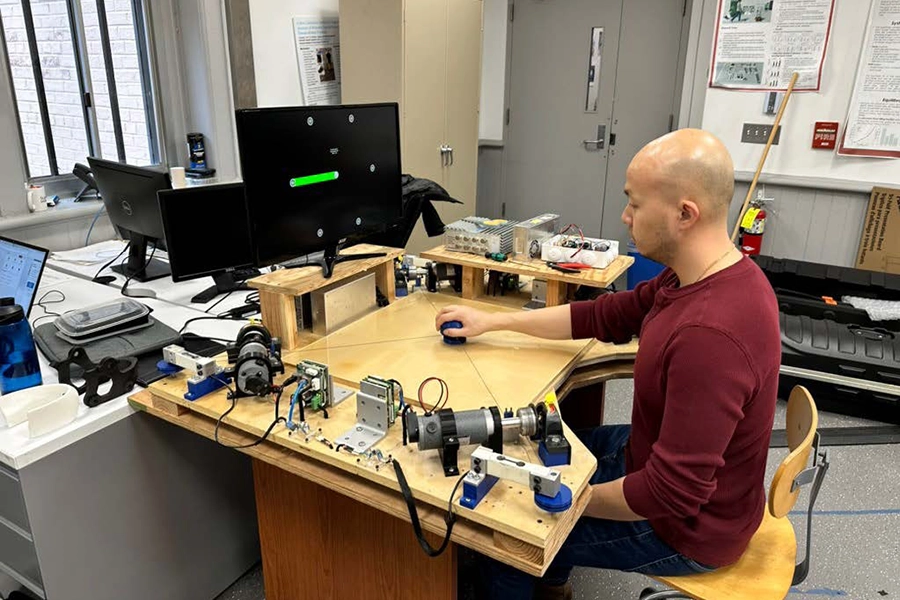
The Challenge: Beyond “Myopic” Robotics Stroke remains a leading cause of long-term disability, with over 800,000 cases annually in the U.S. alone. While robot-assisted rehabilitation offers a scalable solution to the shortage of physical therapists, a critical requirement for neuroplasticity is “active effort.” If a robot does all the work, the patient remains passive, and Stevens Institute of Technology – Robot-Assisted Stroke Rehabilitation

California State University Chico – Scalable Vehicle Platform

Chico Scalable Vehicle Platform Info Box

From Concept to Commissioning Students at California State University, Chico, designed a versatile and scalable vehicle that starts with precision agricultural spraying but aims to push the boundaries of what’s possible. Along the way, these students gained hands-on experience and technical expertise that will empower them to excel in real-world engineering and innovation roles after California State University Chico – Scalable Vehicle Platform

University of Rhode Island – Inverted Pendulum

Uri Inverted Pendulum Info Box

Balancing the Unbalanced: The Story of the Inverted Pendulum Project Ever seen a broom balanced on someone’s finger? That’s the vibe behind one of engineering’s trickiest and coolest challenges: the inverted pendulum. The inverted pendulum problem isn’t just a balancing act—it’s a prime example of real-world control systems, teaching budding engineers how to stabilize things University of Rhode Island – Inverted Pendulum

Penn State Altoona – Electric Drives Lab

Penn State Electric Drives Lab Info Box

Many engineering students graduate without really learning what a servo drive is (including, admittedly, the writer of this article). In an increasingly automated world, it’s important that the engineers of tomorrow are familiar with the technology that makes motion control work. Fortunately, more universities are starting to introduce drives into their engineering curriculum. Among these Penn State Altoona – Electric Drives Lab

Colorado School of Mines – Triaxial Helmholtz Coils

Colorado School of Mines - Triaxial Helmholtz Coils

The Triaxial Helmholtz Coil project by Samuel Osterhout from the Colorado School of Mines demonstrates and explores the physics that build the foundation of motion control technology. Our servo drives are key elements in very complex motion control systems. In the most isolated context, our products regulate current and voltage through wires based on command Colorado School of Mines – Triaxial Helmholtz Coils

Massachusetts Institute of Technology – The Flying Nimbus

Massachusetts Institute of Technology - The Flying Nimbus

Kouttron makes adjustments to the Nimbus. One man’s trash is another man’s future self-balancing skateboard. After stumbling upon a collection of aluminum scrap around the MIT shops and visualizing a skateboard that he could actually ride, Dane Kouttron began developing the Flying Nimbus. Named after a rideable cloud from the Japanese anime series Dragon Ball Massachusetts Institute of Technology – The Flying Nimbus

Rice University – Haptic Paddle

Rice University - Haptic Paddle

Chad Rose demonstrates the haptic paddle operation to undergraduate students. When done with the right tools, hands-on learning can be the best way to help students understand the given curriculum, especially in engineering fields. Since its development in 2006, the haptic paddle has become a staple element of Rice University’s Modeling Dynamic Systems course, taught Rice University – Haptic Paddle